
Outside Tap Installation in the UK: Common Methods Explained
Planning an outside tap installation? Most homeowners call the fitting an outside tap or garden tap. In plumbing guidance, a hose union tap means a tap to which a hose can be connected. It can make watering plants, washing a personal vehicle and other outdoor jobs easier, but there is more than one way to connect one to a home’s cold-water supply.
The right connection depends on the existing pipework, indoor access, wall construction and intended use.
We’ll look at the main outside tap installation methods used in UK homes, along with backflow prevention, isolation and winter protection.
Common Ways to Install an Outside Tap
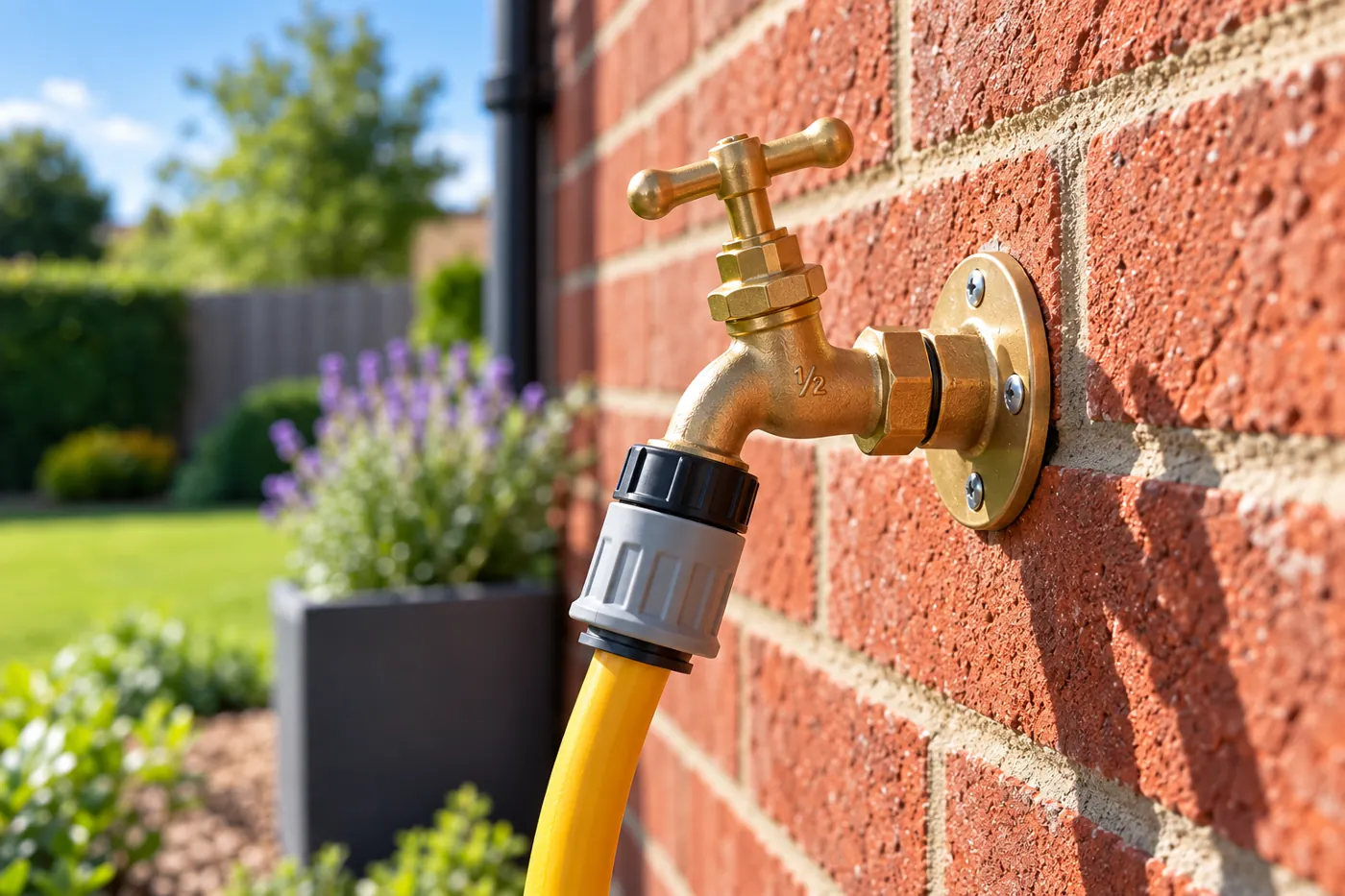
These are examples of how an outside tap can be connected, rather than a set of official installation types. The fittings and route need to suit the property and the manufacturer’s instructions.
Traditional rigid copper pipe connection
One arrangement branches from the indoor cold-water supply and uses rigid copper pipe and suitable fittings to reach the outside wall. An accessible internal isolation point allows the supply to the tap to be turned off separately. The outside tap is then fixed securely to the wall.
Existing plumbing may have compression or soldered fittings. Neither fitting style alone tells you whether the whole installation is suitable: the route, connections, isolation, frost protection and backflow arrangements must also be considered.
Push-fit pipework
Compatible push-fit fittings can sometimes be used with plastic or copper pipe, depending on the system and how the pipe is prepared and supported. Follow the manufacturer’s requirements for compatible pipes and fittings. This is particularly important where pipework passes through a wall or will be concealed.
Push-fit fittings can simplify some pipe connections. However, the installer still needs to plan for access, isolation, freezing and suitable backflow protection.
Flexible-connector and outside-tap-kit arrangement
Some installations use a flexible connection between the indoor cold-water supply and a through-wall or outside-tap assembly. This can be helpful where space is restricted and a short rigid pipe route would be awkward. The connector still has to be suitable for its intended use and installed in accordance with its manufacturer’s requirements.
Flexibility should not be taken to mean that any hose or connector will do. The connection must suit the water supply and the available space without being strained or left vulnerable to damage.
Self-cutting outside tap kits
Self-cutting kits designed for 15 mm pipe are also sold in the UK. Their appeal is that they can provide a relatively straightforward connection where the existing pipe and access suit the product. Limitations include the particular pipe sizes and materials they accept, the space needed to fit them, and their suitability for the intended use.
A kit won’t suit every property. For example, a longer or awkward pipe run may call for a custom arrangement with suitable pipework and fittings. Whatever the connection method, the installer needs to assess the whole outside tap installation, including backflow protection.
Backflow Protection and UK Water Regulations
Why backflow protection matters
Backflow is the unwanted movement of water in the opposite direction to normal flow. A hose attached to an outside tap can come into contact with water or other substances that should not enter the drinking-water supply. That is why an outside hose union tap needs backflow protection appropriate to the highest contamination risk it could reasonably face.
Water Regs UK guidance on hose union taps explains that a hose union tap is a tap to which a hose can be connected. For a hose used solely to water a domestic garden or wash a personal vehicle, the guidance says the risk is typically Fluid Category 3 when the hose is handheld, fitted with a flow-control device and disconnected when not in use. A suitable double check valve may provide protection at that level. The actual setting, potential uses and local water undertaker’s assessment still matter.
Higher risks and valve positioning
Other uses may carry a higher risk. For example, a hose that could be used near a pond or hot tub, or for washing animal areas, can require a higher level of protection. A double check valve should therefore never be assumed to cover every use of an outside tap.
For premises built after 1 July 1999, Water Regs UK gives a specific rule for Category 3 hose union taps. If a double check valve provides protection at that tap’s supply point, it must be installed inside the property. It must also be protected from freezing where necessary. This is distinct from an ordinary shut-off valve: an isolation valve is not, on its own, a recognised backflow-protection device.
The legal framework
The Water Supply (Water Fittings) Regulations 1999 provide the legal framework in England and Wales for preventing contamination and waste of supplied water. Water Regs UK provides practical guidance on applying the requirements to hose taps. Disconnecting a garden hose when it is not in use is also a sensible habit and forms part of the lower-risk domestic-use circumstances described in that guidance.
Isolation and Winter Protection
An accessible indoor isolation point makes it easier to turn off the supply to an outside tap without shutting off the whole house. It is useful when the tap needs attention and can help with winter precautions where the pipework is arranged to be drained. The isolation point’s position should make it practical to reach.
Water can freeze in exposed pipes and fittings, causing damage. How much protection is needed depends on the pipe route, wall and local exposure. Before cold weather, follow the advice appropriate to your installation, disconnect the hose and check for leaks or damage. If you’re unsure about the outside supply, ask an installer to check it. Turning the tap handle off does not protect all the pipework from freezing.
Which Outside Tap Installation Method Is Suitable?
The best arrangement for a particular home starts with a look at its existing cold-water supply. Is the pipe copper or plastic? How far is it from the proposed tap position, and can the route be reached without disturbing other services? Space beneath a kitchen sink or in a utility area may make one connection easier to maintain than another.
The wall construction and the position of the tap affect how the pipe passes outside and how it is supported. Frost exposure matters if pipework or fittings will be in an unheated or exposed place. The intended hose use matters just as much. Ordinary domestic garden watering can present a different contamination risk from use near a pond or for higher-risk cleaning.
Tell the installer where you would like the tap and how you expect to use it. They can then assess access, isolation and the appropriate backflow-protection arrangement. Choose the connection method to suit those practical and regulatory needs.
Outside Tap Installation in Newcastle
Handyman MultiFix helps homeowners in Newcastle upon Tyne and surrounding areas with outside tap installations and related home plumbing work. Explore our handyman and property maintenance services and pricing information.
Need an outside tap in Newcastle? Request a quote from Handyman MultiFix. Please include photos of the proposed tap position and accessible indoor cold-water pipework, and tell us how you plan to use the hose.
What Affects the Cost of Outside Tap Installation?
Installation costs vary with the distance from the indoor cold-water supply, access to existing pipework, wall construction, the fittings required and suitable backflow and frost protection. A straightforward accessible connection may take less work than a longer concealed pipe route. For an accurate quote in Newcastle, send photos of the proposed outdoor position and the accessible indoor supply, or arrange a site visit if needed.
Outside Tap FAQs
What is the difference between an outside tap and a hose union tap?
“Outside tap” describes where the tap is fitted. “Hose union tap” describes a tap designed so a hose can be attached. Many garden taps are hose union taps.
Does an outside tap need backflow protection in the UK?
A hose union tap needs protection suited to the contamination risk and possible uses of its hose. For ordinary domestic garden watering or washing a personal vehicle, a double check valve may be suitable for a Category 3 risk when the hose is handheld, fitted with a flow-control device and disconnected after use, subject to the circumstances and the local water undertaker’s assessment. Higher-risk uses need a different assessment and may need higher protection.
Can an outside tap be connected to the kitchen cold-water supply?
It often can be supplied from accessible cold-water pipework near a kitchen or utility area, provided the pipe, connection route and required protection are suitable. The position of the supply and the proposed outside tap should be checked before choosing the arrangement.
How can an outside tap be protected during winter?
Disconnect the hose and follow the winter instructions suitable for your pipework and fittings. An accessible indoor isolation point can help if the arrangement allows the outside section to be drained. Exposed parts may need further frost protection; ask an installer to check if the route is unclear.